

Share
Four New Killer Sponges: Carnivorous Adaptations in the Deep Sea
Deadly deep-sea predators that trap and digest tiny crustaceans, flipping the script on sponge feeding.
Arthur here. Today’s headline: four new carnivorous sponges discovered by MBARI trap prey with hooks — and the real ocean lesson is the deep sea forces evolution to reinvent survival in food-scarce abysses.

Close-up of Asbestopluma monticola, one of the newly discovered carnivorous sponges.
In 2014, MBARI scientists described four new species of carnivorous sponges (Asbestopluma monticola, Asbestopluma rickettsi, Cladorhiza caillieti, Cladorhiza evae) from the Northeast Pacific, reshaping our view of deep-sea life.

Here’s the twist: while most sponges filter-feed on tiny particles, these “killer sponges” use microscopic hooks to trap small crustaceans like amphipods, then engulf and digest them—an energy-saving hack for the nutrient-poor abyss.
One species even taps into chemosynthetic bacteria near methane seeps, blending predation with symbiosis for ultimate survival.
Why They're Called Killer Sponges
- They ditch energy-intensive filter-feeding for passive trapping in food-scarce depths.
- Found from Pacific Northwest to Baja, often near chemosynthetic hotspots.
- Increase known Northeast Pacific cladorhizids from 7 to 11 species.
Signature Features
- Microscopic Hooks: Spiny structures snag prey like Velcro.
- Mobile Cells: Sponge cells migrate to envelop and digest trapped crustaceans.
- Twig-Like Forms: Resemble bare branches or shrubs for maximum exposure.
Additional Adaptations
- Chemosynthetic Symbiosis: Some species consume methane-oxidizing bacteria for extra nutrition.
- Habitat Versatility: Thrive near seamounts, hydrothermal vents, and methane seeps.
- Unique Spicules: Skeletal elements distinguish species and trace back 200 million years.
- No Filter System: Lack traditional water canals to save energy.
The Real Wonder
- Discovered via ROVs, highlighting the unexplored deep sea's biodiversity.
- Named in honor of scientists and loved ones, like Ed Ricketts and Gregor Cailliet.
- Show how extreme environments drive radical evolutionary shifts.
Arthur’s pocket fact: Carnivorous sponges have been lurking in the deep for 200 million years, as evidenced by fossil spicules—proving the abyss has always rewarded innovative eaters.
The Ping Pong Tree Sponge: Carnivorous Deep-Sea Predator
A bizarre sponge with balloon-like structures that trap and devour prey.
Arthur here. Today’s headline: the ping pong tree sponge uses inflated spheres covered in tiny hooks to snare prey — and the real ocean lesson is the deep sea transforms passive sponges into active hunters.

The ping pong tree sponge, with its spherical "paddles" ready to trap unsuspecting prey.
The ping pong tree sponge (Chondrocladia concrescens) is a deep-sea carnivorous sponge from the family Cladorhizidae, known for its unusual tree-like structure with spherical swellings.
Here’s the twist: those cute "ping pong balls" are actually inflated branches covered in thousands of tiny hooks, acting like Velcro to capture small crustaceans drifting in the currents.
Once snared, the sponge envelops the prey with its cells and digests it slowly, an efficient strategy in the nutrient-scarce deep ocean where traditional filter-feeding falls short.
Why the Name Is Perfect for This Oddity
- Resembles a tree with ping pong balls attached to branches.
- Carnivorous like its relatives, but with a unique balloon design.
- Lives in deep waters where food is rare, forcing predatory evolution.
Signature Features
- Spherical Swellings: Balloon-like structures maximize hook coverage for trapping.
- Tiny Hooks: Microscopic spicules snag prey like a net.
- Sessile Hunter: Anchored to the seafloor, waits for currents to deliver food.
Additional Adaptations
- No Filter System: Lacks water canals, saving energy in low-food zones.
- Slow Digestion: Breaks down prey over days for maximum nutrient extraction.
- Deep Habitat: Thrives in abyssal plains and seamounts worldwide.
The Real Wonder
- Part of a family of over 30 carnivorous species discovered via ROVs.
- Evolutionary link to ancient sponges from 200 million years ago.
- Shows how extreme environments drive radical changes in basic life forms.
Arthur’s pocket fact: The ping pong tree sponge's "balls" aren't for play—they're deadly traps, proving the deep sea has no room for passive players.
The Cockatoo Squid: Mismatched Eyes in the Twilight Zone
A transparent deep-sea squid with asymmetric eyes adapted for dim light hunting.
Arthur here. Today’s headline: the cockatoo squid has one giant eye for spotting shadows above and one small for bioluminescence below — and the real ocean lesson is the deep sea evolves extreme senses for survival in perpetual dusk.
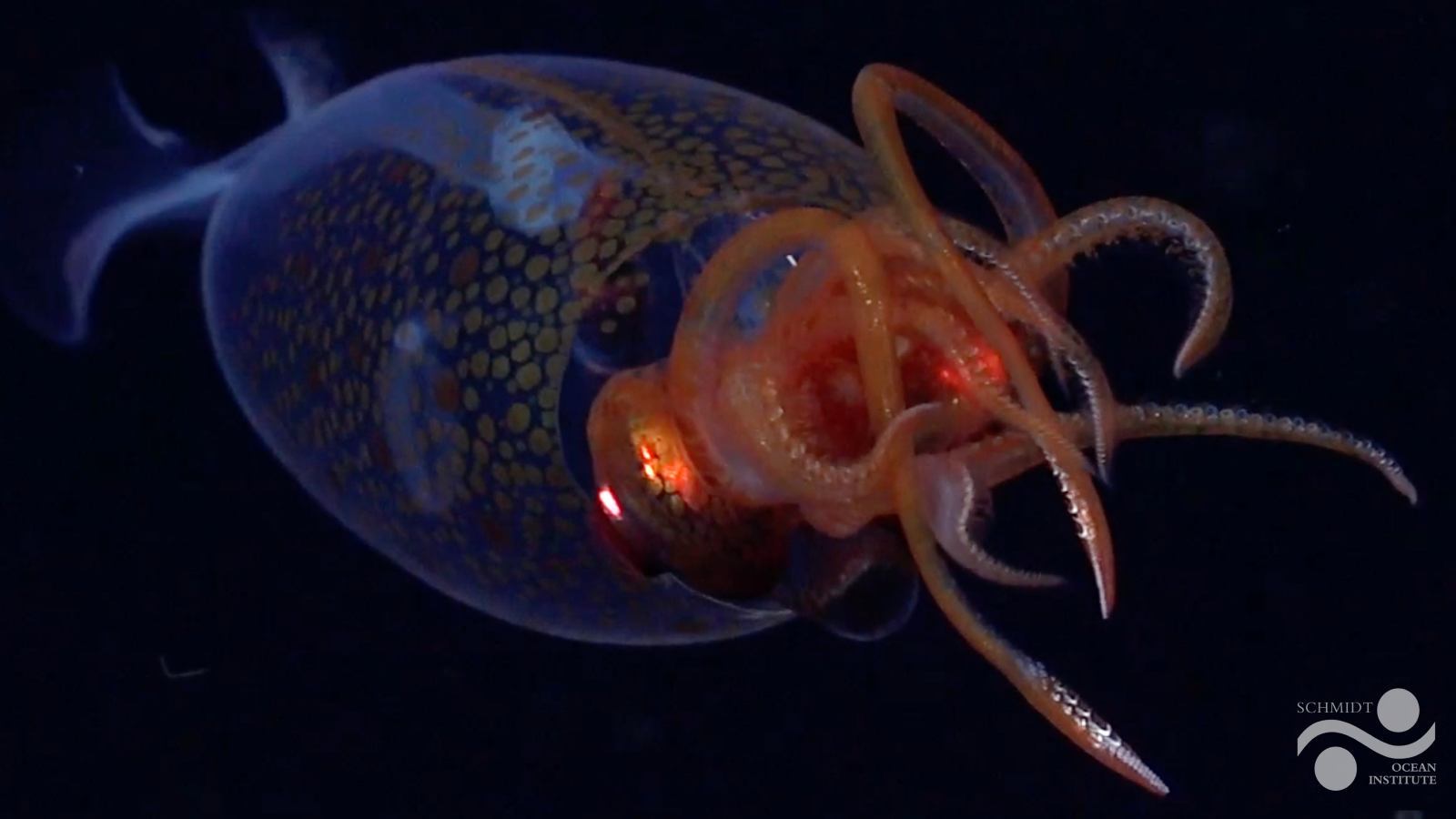
The cockatoo squid, showcasing its transparent body and dotted photophores.
The cockatoo squid (Histioteuthis heteropsis), also called the strawberry squid, is a deep-sea cephalopod known for its transparent body and jewel-like photophores.
Here’s the twist: it has mismatched eyes—one large, yellow eye pointed upward to detect prey silhouettes against faint surface light, and one smaller, orange eye directed downward for spotting bioluminescent organisms.
This adaptation helps it hunt small fish and crustaceans in the ocean's twilight zone, where light is scarce and visibility is key to survival.
Why the Name Captures Its Quirky Charm
- Photophores resemble strawberries; poses with arms like a cockatoo's crest.
- Thrives in dim depths, relying on visual tricks.
- Recent sightings by expeditions like Schmidt Ocean Institute.
Signature Features
- Asymmetric Eyes: One big for up, one small for down.
- Photophores: Light organs for counter-illumination camouflage.
- Transparent Body: Blends into the dark water column.
Additional Adaptations
- Bioluminescence: Uses light to confuse predators or attract mates.
- Cockatoo Pose: Spreads arms to deter threats or maneuver.
- Midwater Habitat: Lives at 300-1000 meters where pressure and cold demand resilience.
The Real Wonder
- Filmed in expeditions revealing twilight zone secrets.
- Represents how cephalopods adapt to extreme visual challenges.
- Highlights ongoing discoveries in unexplored ocean depths.
Arthur’s pocket fact: The cockatoo squid's mismatched eyes are like having built-in binoculars and a flashlight—perfect for the deep sea's split-level lighting.


